- The Handbasket
- Posts
- Whistleblower says Trump officials thought USAID did 'just abortions,' asked for 'Barney-style' slides before gutting agency, per new book
Whistleblower says Trump officials thought USAID did 'just abortions,' asked for 'Barney-style' slides before gutting agency, per new book
Read an exclusive excerpt from Nicholas Enrich's "Into the Wood Chipper"

Marisa Kabas
April 13, 2026
One of the first acts by the second Trump administration was the complete gutting of the US Agency for International Development, a workforce of more than 10,000 people that had administered humanitarian aid and public health support to nations around the world since 1961. Thousands of jobs were immediately slashed by Elon Musk’s para-governmental Department of Government Efficiency (DOGE) and political appointees took over posts previously held by career civil servants. An agency once charged with fighting poverty, curbing the spread of infectious diseases, and promoting education and democracy abroad had been effectively thrown in the woodchipper.
It was during those critical early days that Nicholas Enrich, then-USAID’s acting assistant administrator for global health (GH), witnessed firsthand the carelessness and callousness with which the Trump administration destroyed the agency, ultimately leading to him becoming a government whistleblower. As a result, he was placed on administrative leave for sharing Trump officials’ decision to deny the continuation of life-saving aid, and the lies they told to justify it.
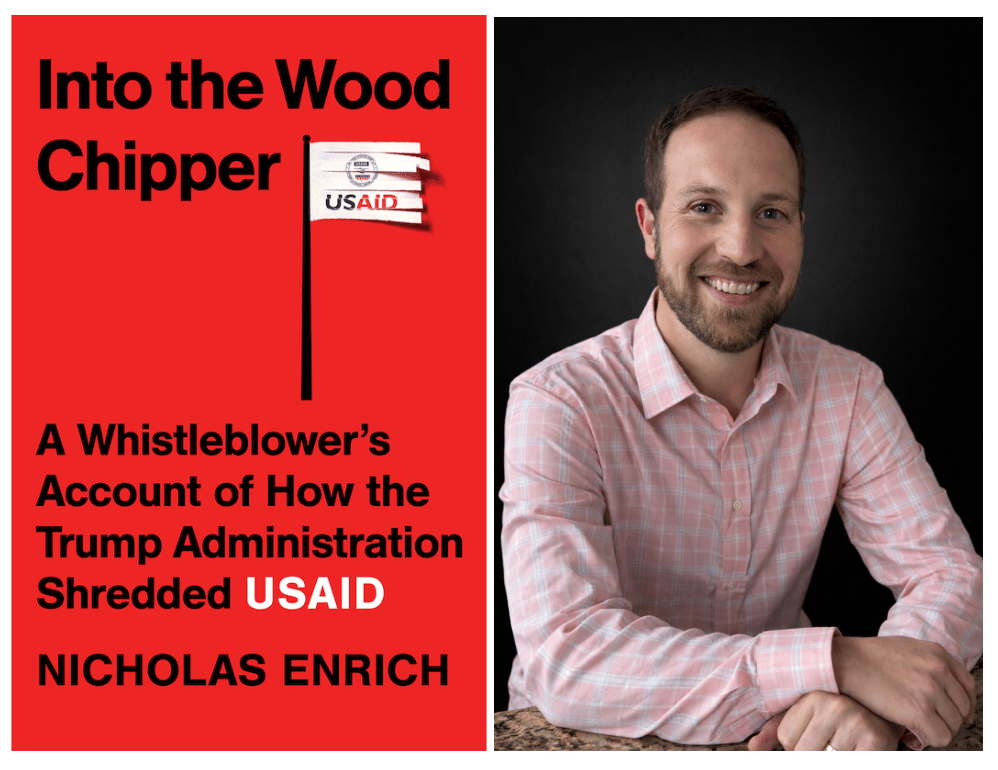
Enrich’s new book “Into the Wood Chipper: A Whistleblower's Account of How the Trump Administration Shredded USAID” will be published on Tuesday, and The Handbasket is proud to share an exclusive excerpt. It shows the scary lack of public health expertise among the Trump team—which included Ken Jackson, who was part of the US Institute of Peace raid—their fundamental ignorance to USAID’s mission—”I assumed it was just, you know, abortions”—and the life or death decisions they forced people like Enrich to make in the name of supposed efficiency. This excerpt details a meeting that took place on February 5, 2025, during which Enrich and his colleagues Nida Parks and Ramona Godbole met with newly-installed Trump officials at the former USAID headquarters to explain their bureau’s critical functions.
You can purchase the book here. Excerpt below:
On Wednesday, Nida, Ramona, and I went to the Reagan Building to finally meet with Joel Borkert and the USAID leadership team. We made our way through the eerily empty headquarters building and entered the administrator’s suite, where we were ushered into the executive conference room. I had last been there years earlier, during the first Trump administration, to brief Administrator Mark Green on our proposed restructuring of our tuberculosis strategy. I remembered nervously trying to answer pointed questions from Green and several of his top deputies, who had relentlessly pushed us to identify opportunities to make our programs more efficient, to maximize local ownership, and to propel host governments toward self- reliance, reducing the need for foreign assistance from the United States.
Today, the room felt emptier, devoid of the expertise and experience that had so often directed policy from within its walls. Besides the three of us from GH, the group consisted of Joel Borkert (USAID’s chief of staff), Adam Korzeniewski (White House liaison), Meghan Hanson (director of policy), Paul Seong (senior advisor to the administrator), and Ken Jackson (with Pete Marocco’s new designation as deputy administrator, Ken’s title was revised to acting deputy administrator for management and resources). Jason Gray (briefly the acting administrator, now back to chief information officer) joined as well. The group looked tired and bored, and I got the sense that we were not the first bureau to brief this group on our “mission- critical functions” that afternoon.
Without introductions, Joel, who was eating a frozen Indian dinner, jumped right in. “In full transparency, we’re drawing down USAID,” he said. “We’d like you to walk us through your mission-critical functions so that we can close things out smoothly. What are the key priorities that we need to keep working on in GH, and the staff needs to carry them out?”
Draw down. Close out. The words he dropped so casually rang in my head. Our global health programs didn’t concern him, he was only interested in the quickest way to shutter the agency. I knew this was my only chance to make him see why our work mattered.
“Thanks, Joel,” I began. “With the current pause on foreign aid, we’re primarily focused right now on the waiver to restart our lifesaving activities. But emergency response is only a tiny fraction of our work. So much of what we do is to strengthen sustainable health systems around the world for long-term health improvements. Let me tell you about that work as well as some of the more urgent needs.”
Joel, who had been checking his watch, shrugged and took another bite of his microwaved paneer. Just as I was about to go on, Paul Seong spoke up. “I’d say just stick to the lifesaving stuff,” he said. Aside from Jason Gray, Paul was the only career official representing the front office in this meeting. My only prior engagement with Paul was the Ebola briefing on Monday after which he had asked for the names of the meeting’s participants, who had been the only staff spared from administrative leave that day. Paul had been a relatively junior foreign service officer until recently, when he had somehow ingratiated himself with our new political leaders. Now the political appointees seemed to look to him for strategic advice on how to tear down the agency, and he appeared to relish his newfound influence, which was affirmed by his seat at the center of the conference table. Joel and the others nodded their agreement.
Disappointed, though not surprised, I began to describe various life- saving components of USAID’s global health portfolio, highlighting how we prepare for and respond to emerging pandemic threats; support the diagnosis and treatment of tuberculosis, malaria, and HIV; and immunize millions of children from the deadliest childhood diseases. I spoke for about five minutes, focusing primarily on our infectious diseases work and hoping to keep the attention of people who seemed to have no experience—or interest—in global health.
When I finished, the room was silent, the political appointees looking at one another in what appeared to be disbelief. The silence was broken by Ken Jackson, who chuckled softly and shook his head. “Wow, there really is so much that USAID does that we never knew,” he said. “This is the story that needs to get out there.”
Joel, also smiling, chimed in next, echoing Jackson’s amazement. “I had no idea you did all this,” he said. “As a Republican, when I think of what USAID does in global health, I assumed it was just, you know, abortions.”
I didn’t know whether to laugh or cry. My first thought was to explain that no global health programming supports abortions. Providing or promoting abortions with foreign assistance funds is illegal, and we had robust systems in place to ensure that no U.S. funds were used to support abortions. But obviously, arguing with Joel would get me nowhere. Mostly, I was shocked to hear how unapologetically ignorant our new leaders were about USAID’s work. Just the night before, they had triumphantly announced that nearly the entire agency was being placed on administrative leave, clearly without having a clue as to what we did. I willed myself to avoid eye contact with Nida or Ramona, knowing that seeing their expressions would lay waste to my twitching attempt at a straight face.
The first question came from Adam Korzeniewski, a veteran of the first Trump administration where he served short stints with the departments of Treasury and Commerce. Adam, the White House liaison to USAID, wanted to know more about the risks associated with interruptions to TB clinical trials, which I had mentioned in my overview. He was the only participant in this meeting who appeared genuinely happy to be there, and he was wearing a USAID lapel pin on his suit jacket, in what I could only explain as an apparently ironic nod to the agency he was charged with destroying. I found it odd and vaguely offensive, like a vindictive landlord throwing a farewell party for a tenant he was in the process of evicting.
“Some of the studies are testing new treatment regimens for drug- resistant tuberculosis,” I explained, hoping I could convey the very real danger in terms that would register with this audience. “Thousands of enrolled patients are at risk now that their lifesaving treatment is stopped. But that’s not the only danger. We only have limited options to treat drug- resistant TB. We’re using our antibiotics of last resort in these trials. Interrupting treatment midstream risks the development of new, even more drug-resistant strains that could be untreatable. For an airborne infectious disease, that is a serious national security risk.”
Adam thought for a moment and then responded, noting that the political appointees at USAID were “not health people.” It would be hard, he surmised, for nonexperts to understand this issue. And so he suggested that we draft a simple, “Barney-style” set of slides to help the political leadership grasp the dangers, referring to the purple dinosaur of children’s television. He recommended that we use the term “Super TB” instead of “drug- resistant TB” to describe the mutations that can develop when treatment is interrupted, because it might be more likely to “catch their attention.”
Adam then made clear that he did not count himself among those po- litical appointees who were not health experts. Though he had no relevant training or experience, he reassured me that he understood the severity of infectious diseases, noting that he had recently read a book about smallpox. Apparently he had watched movies as well.
“One thing I thought of while you were talking,” he added, gesticulating wildly with his hands to conjure the image in his mind. “If you can make one of those maps like they have in Outbreak, where it shows the red growing over time as the disease spreads? You know, like the zombie apocalypse? That would be great, very effective.”
The thought that Adam might have the most health expertise of anyone in the agency’s leadership made me shudder.
Meghan Hanson, who had been appointed days ago as USAID’s new director of policy, focused on my warnings related to the interruption of activities needed to prevent the spread of malaria, one of the world’s leading killers of children. I had noted that the rainy season was fast approaching in many of the African countries with the highest burden of malaria, and that the annual preparations to combat the disease—indoor residual spraying, distribution of bed nets, delivery of commodities for testing and treatment—had all been stopped.
Hanson seemed to grasp the urgency. “We need to get those activities turned back on right away,” she said. “Write up the details, including the number of lives at risk, how quickly the interventions are needed, and where, and get that to us tonight!”
I told her that we would prioritize this action. But, I reminded her, all the malaria division staff—the entirety of USAID’s malaria expertise—had been shut off from USAID’s network, making it extremely difficult to pull together accurate information quickly.
At this, Joel’s exasperation with DOGE’s meddling boiled over, and he shouted at the room: “See, this is why, just because it might work at Twitter does not mean you can do it here!”
I shifted uncomfortably in my chair. If the political appointees in this room—tearing down USAID without any comprehension of the consequences—felt that DOGE’s tactics were reckless and destructive, we were in deeper trouble than I had realized.
Following another long silence, Joel summarized what we needed to do next. My description of our lifesaving work had been helpful, and we would need to develop “a very simple way to describe it to the secretary,” he told us. “To be clear, we’re not looking for a laundry list of everything you want to do, you’re going to have to cut things, it’s going to have to be draconian. You’re only going to get things that are priority number one, that is all we’re going to be able to do, so don’t even send up the things that are priorities number two, three, or four.”
At that point, Nida jumped in. Out of the corner of my eye, I had noticed her picking nervously at her hands for most of the meeting, and I knew it was just a matter of time before my oft-impatient colleague spoke up.
“Can I just clarify one thing?” she asked, not waiting for a response. “This group seems very focused on what GH does to respond to infectious diseases, but we haven’t spoken much about our other lifesaving work. Just as one example, we support lifesaving care to mothers for emergency inter- ventions like postpartum hemorrhaging and eclampsia, two of the leading causes of pregnancy-related deaths. You would also consider that kind of work to fit into our ‘priority number one,’ right?”
Another brief silence followed as Joel watched the clock, and it was Paul Seong who broke it. “I’d say that’s more of a number two,” he said dismissively, looking to Joel and Ken for affirmation.
“That sounds right,” Joel agreed, and the others nodded. Nida, shaking visibly, scribbled furiously in her notebook. And just like that, it was decided. Without even a cursory nod to data or expertise, USAID’s leadership had determined purely on a whim that lifesaving maternal health services were not a priority for this administration.
Finally, Joel told us where things now stood. “As I said, the decision has been made to draw down USAID,” he said. “My job is to make sure it goes smoothly, and I need your help with that. I need you to tell me which individuals you need to do those few core remaining activities. It’s gotta be lean, but if you need us to bring a few people back to life—turn them back on—we can do that. Everyone else is going to stay off.” He glanced at Jason Gray, who apparently was in charge of turning people on and off. Jason nodded, almost imperceptibly, without looking up.
As the meeting ended, I reminded Joel that we were still waiting on his approval of our approach to implement the waiver for lifesaving activities, and that we had also sent him several requests to initiate our increasingly delayed response to the Ebola outbreak in Uganda. Then we were ushered out to the elevator.
Ramona, Nida, and I sat in the food court in the basement of the Reagan Building, trying to process the meeting we had just left. It was simply shocking that the group currently sitting in the administrator’s suite was the team that was making decisions about USAID’s future. They were not real policymakers, but impostors, sitting in big chairs and pretending to grapple with complex issues that required teams of experts, who they had just off-loaded. Clearly, they hadn’t considered how their plans to dismantle USAID might affect lives around the world or the health and safety of Americans. Now, having heard my warnings, they were not actually interested in—or capable of—finding a solution to prevent people from dying.
Their job was to tear down the agency as quickly and quietly as possible, receive their pat on the back from Pete Marocco, and move on to whatever was next.
Ramona, Nida, and I had been dismissed from the meeting with an impossible assignment: to provide a “draconian” short list of global health activities to maintain during the “drawdown” and a rank-ordered list of the staff needed to accomplish them. We did not know where to start. Were we really supposed to just abandon all of USAID’s programs to strengthen health systems, even though they were the key to our sustainable development goals? Had they really just deprioritized our maternal and child health programs in front of our eyes? And how could we even begin to rank our staff?
Ramona summed things up: “They’re asking us to dig our own grave.”
Excerpted from Nicholas Enrich's Into the Wood Chipper: A Whistleblower's Account of How the Trump Administration Shredded USAID, to be published on April 14th by Summit Books, an imprint of Simon & Schuster.
Reply