- The Handbasket
- Posts
- 'To Catch A Fascist'
'To Catch A Fascist'
Read a sneak peek of the new book by veteran journalist and far-right extremism expert Christopher Mathias.

Marisa Kabas
February 05, 2026
When veteran journalist Christopher Mathias set out to write a book about fascism, it was the center of his professional world; but now in 2026, it’s the center of all of our worlds, making To Catch a Fascist both a history lesson and an urgent warning.
Below is an excerpt from the book which just hit shelves this week, along with a brief intro from Mathias himself. It’s an excellent read and you should buy it (and I’m not just saying that because there’s a blurb from me on the back.) And if you’re in NYC, we’ll be discussing it together live tonight at the Brooklyn Public Library, Brooklyn Heights branch. Details here.
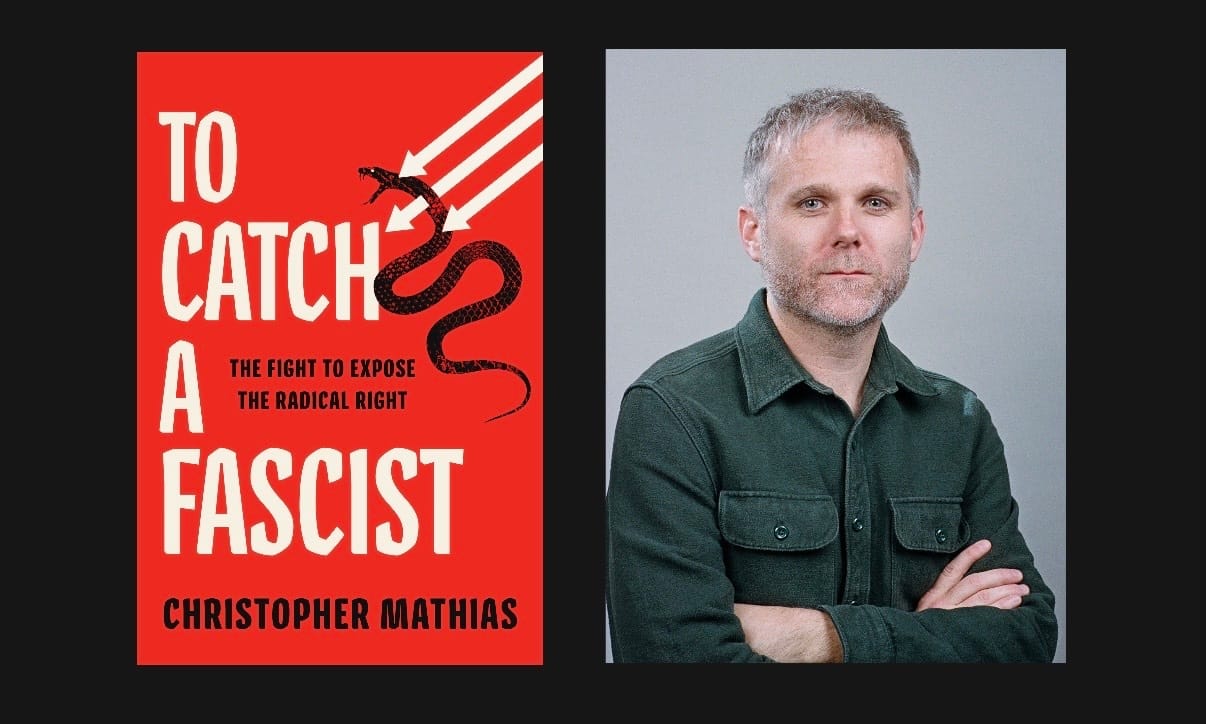
According to an executive order signed by President Donald Trump, the heroes of my book are “domestic terrorists.” To Catch a Fascist: The Fight to Expose The Radical Right, after all, follows activists in antifa as they surveil, infiltrate, confront, and ultimately destroy multiple fascist groups in the Trump era.
Trump’s executive order, signed in September, claimed to officially designate antifa a “domestic terrorist organization.” It was absurd as it was alarming. There is no federal law by which to make such a designation. Moreover, antifa is not even an organization. It is a militant tradition or style of politics dedicated to destroying the far right “by any means necessary.” There is no headquarters for this underground network of radical leftists—most identifying as anarchists, socialists, and communists. There are no leaders. No billionaire benefactors.
As my book details, the ranks of antifa are made up of everyday Americans who lost faith in the ability of their institutions to protect them from the rising tide of fascism in America. They came to intimately understand the axiom of “we protect us” and took matters into their own hands. Although best known for punching Nazis, the bulk of the work antifa did over the last ten years was to spy and expose a new generation of far right groups, ultimately unmasking thousands of people—among them police officers, politicians, pastors, teachers, lawyers, and soldiers—as secret neo-Nazis.
One of those antifa activists is a man we’ll call Vincent, who went undercover into a group called Patriot Front. Below is a scene from Vincent’s remarkable infiltration of the secretive group, which eventually contributed to the unmasking of some 80 fascists.
Thanks so much for reading. I truly think you’ll love my book and I’d love it if you bought it or checked it out from your local library. ~ Christopher Mathias
The next three months were a blur of activity. Vincent said yes to everything—every banner drop, every propaganda mission, every gathering—so that he could earn everyone’s absolute trust, so that they’d be more liable to slip up and reveal clues to their identities, and so that he’d be wise to every detail of the December 4 march. Which is how he found himself one day in an apartment in the Interbay neighborhood of Seattle, watching Tyler show off his recently manufactured “ghost gun.”
“This is a P80 frame,” Tyler explained, sitting beneath a Nazi battle flag hanging from the wall, cocking his new black pistol.e “It’s been good . . . I like the P80 frames more than a Glock, the way they feel in your hand, more of a 1911 angle . . . Plus, it’s not on paper.”
Vincent knew enough about guns to know what “not on paper” meant: Tyler’s pistol didn’t have a serial number, meaning it couldn’t be traced to a record of sale. If there came a day when cops were trying to find the owner of this gun in Tyler’s hand, they’d have a hard time doing so. These “ghost guns,” like Tyler’s P80, were sometimes made from kits bought online, with gun components that could be assembled at home into a workable firearm. It was, to gun control advocates’ dismay, largely legal to do this. (It has since been outlawed in Washington state.) Other ghost guns are made with 3D printers, like the 3D printer in Tyler’s apartment, which Vincent suspected he was using to manufacture other guns. Just the month before, the US Joint Counterterrorism Assessment Team had issued a six-page report warning about the rise in “violent extremists” seeking “ways to acquire firearms through the production of privately made firearms.” The report pointed to a series of alarming incidents. In July 2021, a twenty-one-year-old national guardsman was indicted in North Carolina for allegedly supplying ghost guns to an Idaho-based cell of neo-Nazis made up of other US servicemen.In 2020, the FBI found an AR-15 ghost gun in the Delaware apartment belonging to three members of The Base, an accelerationist neo-Nazi group, who had allegedly plotted to open fire at a gun rights rally in Virginia as a way of kicking off the “boogaloo,” white supremacist parlance at the time for “race war.” In 2019, authorities revealed that a South Carolina white man, while attempting to hire a hit man to lynch his Black neighbor and erect a burning cross in his yard, had also tried to obtain a ghost gun. That same year, Seattle police seized ghost gun parts from the home of a leader in the Atomwaffen Division, the murderous neo-Nazi group. And in 2018, a nineteen-year-old college student in Chicago—known around campus for wearing a Patriot Front T-shirt—was sentenced to probation after cops found a small arsenal of illegal ghost guns in his home.
Tyler cocked his pistol again and placed it on his workstation, next to the 3D printer. He also used the printer to create Patriot Front stencils. He was one of only a few members in the whole organization responsible for manufacturing the stencils, the thin sheets of metal with slogans cut into them—Not Stolen, Conquered, and Defend American Labor and Reclaim America—that were used to spray-paint messages on top of “opposition” or “adversarial” murals, which was Patriot Front lingo for public art featuring Black and queer people. Taken altogether, one could say Tyler was running a little hate crime factory out of his apartment.
Tyler had invited Vincent, Charles, and Clark over to work on the stencils. Charles was the quarter-Filipino kid Vincent had met at the diner, the one who was maybe too young and not white enough to be in Patriot Front. Clark had been at the hike up Mount Rainier, but Vincent hadn’t talked to him much. Tall and skinny with a buzz cut, he looked to be in his mid-twenties and seemed well-to-do, like he’d grown up comfortably.
Tyler and Vincent started to talk about how many stencils they had, taking a quick inventory. As Tyler listed all the different stencils, Vincent took out his phone, pretending to write down everything Tyler was saying in his Notes app, but instead flicked over to his camera and snapped a photo: Tyler, leaning back in an office chair, next to the ghost gun on the workstation, and beneath his flag, which had an Odal rune in the corner, a symbol used in the divisional insignia of Waffen SS divisions during World War II, and a sonnenrad symbol in the center, the “black sun” also used by the Nazis, most infamously on the tiled floor of the remodeled German castle that belonged to Heinrich Himmler, the architect of the Holocaust.
Tyler seemed to trust Vincent enough to let him mosey around the apartment unaccompanied, allowing Vincent to poke around for clues about Tyler’s real name and his place of employment. He searched his bathroom cabinets, studied the magnets on the fridge, and snapped a photo of Tyler’s key chain, which included a membership card for LA Fitness. It was clearly a bachelor pad. Tyler’s girlfriend, Rachel, who Vincent had talked to on the climb up the volcano, lived in another neighborhood. Eventually, Vincent found himself looking at the books on Tyler’s shelf. Charles started to do the same, removing a large book and flipping through the pages. He read the title aloud: “Unintended Consequences.”
“Have you read that?” Tyler asked him. “Not a lot of it,” Charles replied.
“I’ve only met one other person who’s read that whole book.” “It’s huge.”
“If you want a book that’s total war on the ATF, it’s a good one,” Tyler explained, referring to the Bureau of Alcohol, Tobacco, and Firearms (then federal agency that had reported recovering ghost guns like Tyler’s at the scenes of nearly seven hundred homicides and attempted homicides in the previous five years). “If you like guns and want a fantasy of waging war on the ATF, borrow it.”
Written in 1996 by a Second Amendment enthusiast named John Ross, Unintended Consequences is a blood-soaked fantasy imagining a white south-ern man who rebels against gun control laws he views as oppressive, killing ten ATF agents, then butchering their bodies and feeding them to hogs.27 The act inspires a mass armed revolt, organized by “leaderless resistance,” in which a decentralized network of militias carry out attacks, eventually leading to the downfall of the US government. Ross claimed the book was a smash hit, selling over sixty thousand copies, largely from purchases at gun shows.28 By 2013, The New York Times noted Unintended Consequences was among the “100 most sought-after titles currently out of print.”
“Unintended Consequences,” Charles said. “I imagine it’s a more flushed-out version of The Turner Diaries.”
Charles wasn’t the first person to note the similarities between the two books. The Turner Diaries is a 1978 novel written by William Pierce, leader of the neo-Nazi group National Alliance. His book also imagines a bloody revolution, albeit with much more explicit white supremacist themes, includ-ing the “day of the rope,” in which “race traitors”—namely certain journalists, professors, lawyers, clergy, and other leftists—are lynched en masse. The Turner Diaries has inspired multiple acts of white supremacist terrorism, including the 1993 bombing of the Alfred P. Murrah Federal Building in Oklahoma City, which killed 163 people. “If people say The Turner Diaries was my bible, Unintended Consequences would be my New Testament,” Tim-othy McVeigh, the Oklahoma City bomber, said after reading Unintended Consequences while in jail awaiting trial. “I think Unintended Consequences is a better book. It might have changed my whole plan of operation if I’d read that one first.”
Charles put the book back on the shelf.
The four of them started to add the finishing touches to Tyler’s 3D-printed stencils, cutting out the letters and then practicing spray-painting over them on pieces of cardboard. Tyler realized he needed a tool he’d left in his work van outside, he said. He’d be right back. Vincent walked over to the window, looking down onto the street below, and observed Tyler approach a white van with two ladders tied to the top, and with black lettering on the side. Key Mechanical, it said. Tyler opened the back doors of the van and started rummaging inside. Vincent looked around to make sure Charles and Clark weren’t looking. He held his phone up to the window and snapped a photo.
Copyright © 2026 by Christopher Mathias. From the book TO CATCH A FASCIST by Christopher Mathias, published by Atria, an Imprint of Simon & Schuster, Inc. Printed by permission.
Reply