- The Handbasket
- Posts
- US Mint takes down video of meeting criticizing proposed Trump 24K gold coin
US Mint takes down video of meeting criticizing proposed Trump 24K gold coin
A coin advisory committee called the design for the America 250 coin something only produced by "kings or dictators."

Marisa Kabas
March 17, 2026
If you want to support my 100% independent journalism, subscribe to The Handbasket for free now. You can also become a premium subscriber or leave a tip. (Also, The Handbasket is now on Instagram. Follow here for news updates.)
Julius Caesar started off 44 BCE feeling pretty good: In January, as the story goes, the Roman Senate renewed his appointment as dictator, and the following month, they decreed he’d serve as dictator “for life.” They also announced that Caesar’s portrait would appear on coins—the first time any living Roman had appeared on currency. By March, he was murdered. So what does this have to do with Donald Trump?
In the ultimate culmination of Trump’s interests, the US Mint may soon produce a 24-karat gold commemorative coin bearing his image. It’s part of the celebration of America’s 250th anniversary—otherwise known as the semiquincentennial—and, if produced, would be in addition to a proposed one dollar coin with Trump’s image that was previously announced. Now The Handbasket is first to report that, per multiple members of a government coin committee, video of their recent meeting during which they voiced strong objections to the Trump coins’ production—because “no nation on Earth has issued coins with the image of a democratically-elected leader during the time of their service”—has disappeared from the US Mint’s Youtube page. While this particular instance of federal censorship is about coins, the larger message is loud and clear: Dissent will not be tolerated.
The Citizens Coinage Advisory Committee (CCAC), an impartial group that advises the Treasury Department on issues of design, held their most recent meeting on February 24th. Prior to that, the Mint added an agenda item to the official meeting notice reading: “review and discussion of a Semiquincentennial Gold Coin.” However, acting CCAC chair Donald Scarinci announced at the outset of the meeting that he was using his discretion to remove the agenda item, in addition to any talk of the one dollar coin, because “Only those nations ruled by kings or dictators display the image of their sitting ruler on the coins of the realm."
The following day, Dan Barry at the New York Times published a story about the meeting. Three hours later, Scarinci told The Handbasket, the recording was gone.
In an email to Mint leadership sent on February 25th—the text of which was reviewed by The Handbasket—Scarinci asked that the video of the meeting be restored online. Mint officials replied that they would restore it and that the transcript would be published to CCAC’s website (which is controlled by the Mint), but neither of those things have happened. If the video isn’t restored before the next meeting on April 18th, Scarinci plans to ask the Mint for an explanation as to why the video was removed, and if necessary, take a vote among committee members to bring it back.
Requests for comment from multiple representatives at the Mint about the removal of the video and the status of the Trump coins received no reply as of this publishing. A copy of the video has been uploaded by one of the CCAC members, which you can view here.
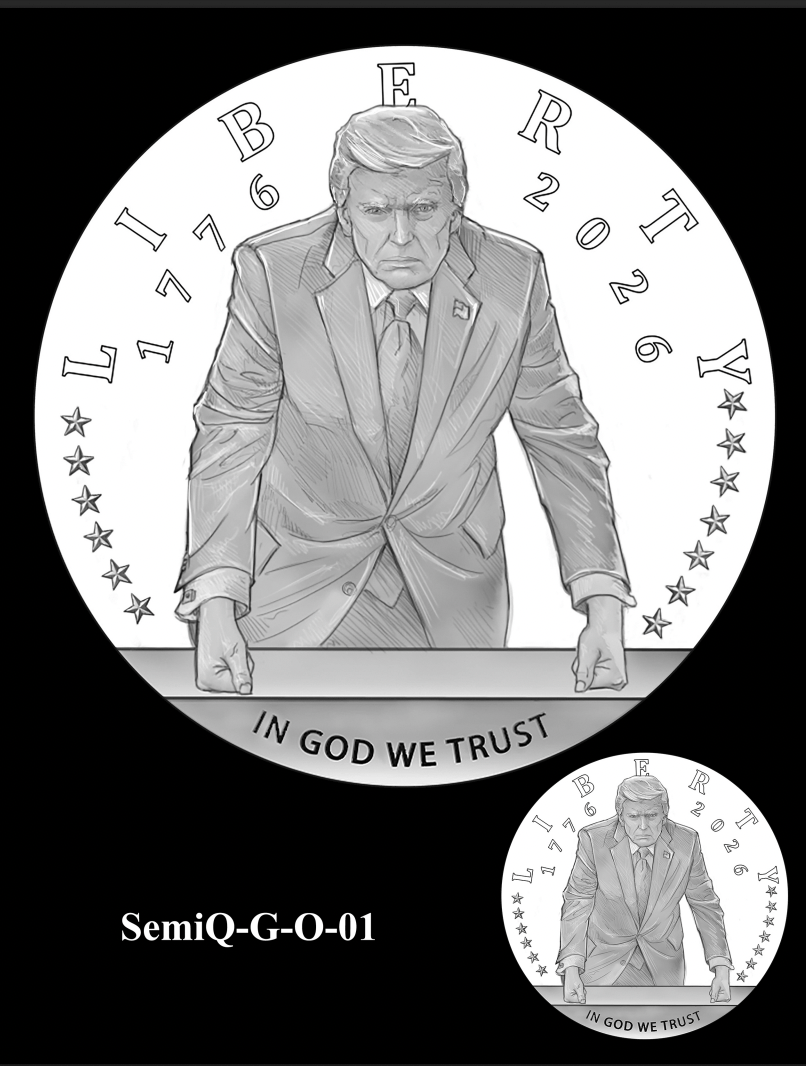
I first learned about the gold coin not because of the Times story, but because someone flagged the agenda for this week’s meeting of the US Commission of Fine Arts. It states that the Mint will be presenting “2026 Semiquincentennial Coin Program (24-Karat Commemorative Coin - President Donald J. Trump). Designs for obverse and reverse. Final.” The agenda links to a PDF of a design that shows a menacing-looking Trump with balled fists resting on a desk, the word “LIBERTY” in all caps above his head like a halo, the years 1776 and 2026, and “IN GOD WE TRUST” on the bottom. It is a replica of the photo of Trump that now hangs in the National Portrait Gallery. The flip side is an equally-menacing bald eagle atop a perch.
The Commission of Fine Arts (CFA) is an independent federal agency that, per the Federal Register, is “charged with giving expert advice to the President, Congress and the heads of departments and agencies of the Federal and District of Columbia governments on matters of design and aesthetics, as they affect the Federal interest and preserve the dignity of the nation's capital.” They’re tasked with providing advice to the Mint on the design of coins and medals, which is why they’re involved with the Semiquincentennial Coins & Medals—AKA SemiQ—project.
The US Mint presented three different designs for the front of the one dollar coin at the CFA meeting in January. In a subsequent letter to US Mint Director Paul Hollis, CFA Secretary Thomas Luebke wrote: “The Commission members recommended obverse #3 and reverse #5—comprising a side profile of President Donald J. Trump and the heraldic eagle from the Great Seal of the United States—as a classic pairing reminiscent of early twentieth-century coins. For the obverse, they praised this alternative for its statesman-like and accurate depiction of the President.”
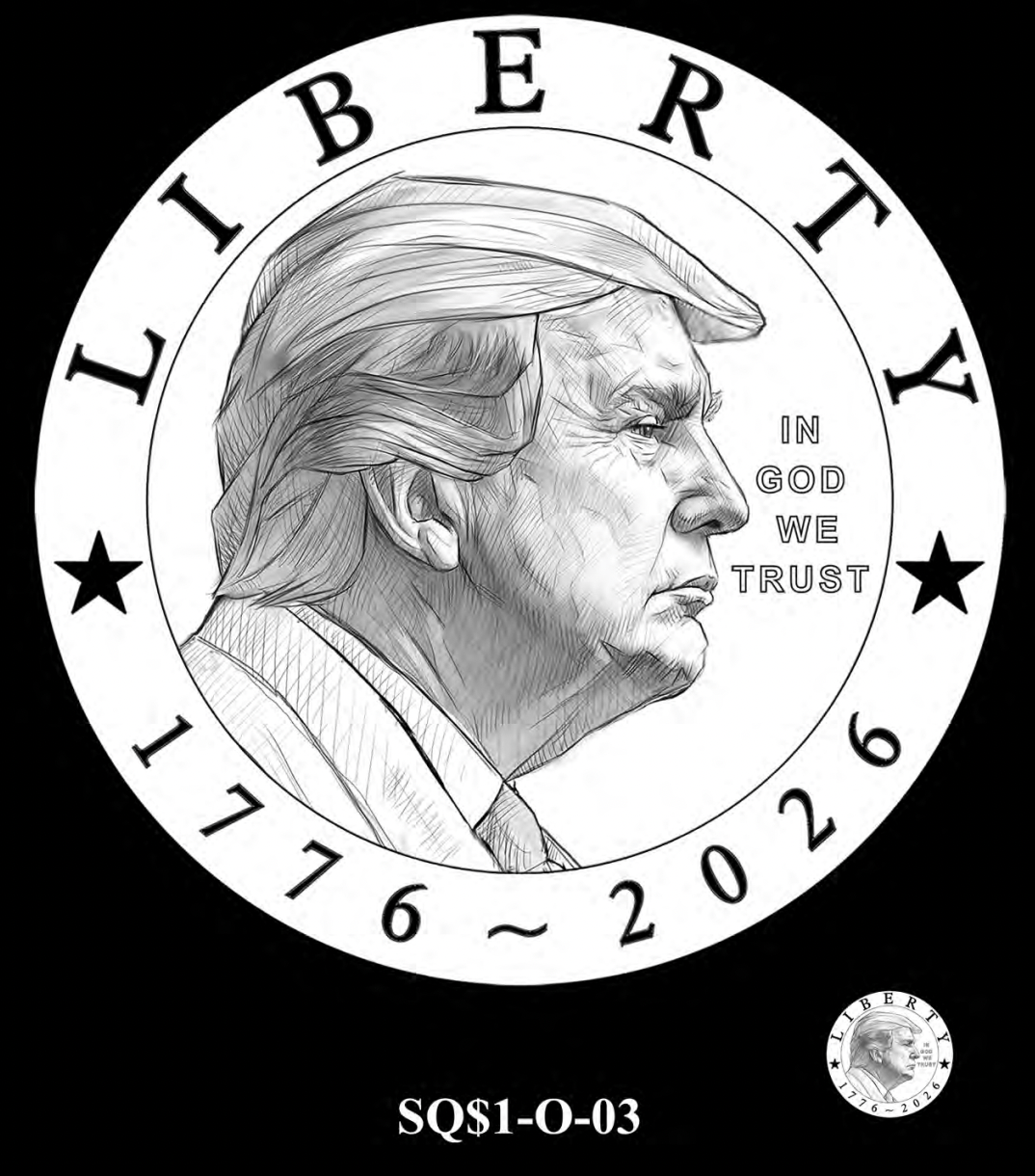
Proposed one dollar coin design (US Mint)
This response was despite Public Law 116-330 which states, “No head and shoulders portrait or bust of any person, living or dead, and no portrait of a living person may be included in the design on the reverse of any coin.” Megan Sullivan, acting chief of the Mint’s Office of Design Management, told the CFA at their January meeting that “the legal research has been done … and they have determined that this does not violate any laws, that this, is perfectly, legal … under the Circulating Collectible Coin Redesign Act.” It’s unclear what exactly that research entailed.
This laudatory review of the one dollar coin design is no coincidence: Trump dismissed all the members of the CFA back in October reportedly to “appoint a new slate of members to the commission that are more aligned with President Trump's America First Policies." In January, he appointed Rodney Mims Cook, Jr. as Chairman, plus six other members of the commission. Those new members include two with no discernible arts expertise: Chamberlain Harris, the current Deputy Director of Oval Office Operations at the White House who graduated college in 2019; and Pamela Hughes Patenaude, a Deputy Secretary of HUD during the first Trump administration. The commission rubber stamped Trump’s White House ballroom project after being presented with revised plans in February.
“President Trump has an incredible eye and appreciation for the arts, and only selects the most talented people possible,” a White House spokesperson told Politico of the new commission members after the ballroom approval. Now those same “talented” eyes will gaze upon the proposed gold coin design for approval.
In a phone conversation on Tuesday, Scarinci explained how the February 24th meeting was immediately contentious, and the subsequent sharp questioning of Mint legal counsel Greg Weinman by CCAC board member Kellen Hoard added to the seriousness.
“Over the last several months, the committee has been faced with a number of challenges unprecedented in its history,” Hoard began. “These challenges have resulted in a lack of legal, procedural, and operational clarity, which directly impacted the ability of the committee and its members to fulfill their responsibilities in the years to come.”
Hoard read aloud an email he sent to Mint officials in December letting them know he believed the selections of the American 250 quarter designs—ones that do not feature Trump’s name or face, but images of American themes—were made “in violation of the law” because they were never okayed by his committee. Hoard never received a reply to his email, and despite his salient objections, the Mint has since gone ahead with producing the quarters anyway.
The ultimate design discretion for the Trump gold coin lies with Treasury Secretary Scott Bessent. As opposed to commemorative coins with actual denominations that require Congressional approval, the gold coin is discretionary, meaning the secretary can authorize it on his own without CCAC review. Still though, there was something unique about this discretionary coin: Mint representatives said the idea for the gold coin came from “outside the agency.” That “has never happened before in my 20 years there,” Scarinci told me.
Commemorative gold coins are not unheard of. Right now you can purchase one with an image of Wonder Woman, part of the Mint’s Comic Art Coin & Medal Collection. The Wonder Woman coin retails for $4,110. It’s unclear if it’s produced how much the Trump gold coin will be sold for, but Scarinci explained the price will include a premium over the price of gold, which right now is $5,000 an ounce.
As a member of the CCAC since 2005, Scarinci has been appointed by seven different Treasury Secretaries to continue his service. A lawyer based in New Jersey, he’s the owner of the largest private collection of art medals in the country, and even published a book in 2015 called Coin of the Year. (Naturally, he was the one who flagged the Caesar anecdote for me.) And it’s because of his devotion to the art form that he was so perturbed by President Trump’s desire to flout tradition and, it appears, the law, to see his own face on a coin.
“We're celebrating the 250th anniversary of the Declaration of Independence, which was the document that enabled a revolution against kings,” Scarinci said. “And to celebrate our declaration of independence against rule by a king with a coin that has an image of a living, serving, president of our country, that is a slap in the face to the founders, to George Washington, and a statement to the world that [Trump] is a king.”
The CFA and Treasury Department did not reply to requests for comment on the production of the Trump coins. CCAC will continue to object to being left out of this process, Scarinci said, and hopes Congress will step in to prevent production. Aside from that, the committee has little recourse.
“You know what’s particularly scary about this?” Scarinci asked. “This conversation is about a coin. They have reached into coins.” I replied that this administration can’t withstand any criticism, even about a coin. “This is valid criticism based on history, and they don’t even want to hear that,” Scarinci said. “They wanna do what they wanna do, and they don’t really care what anyone else has to say about it. That’s the message.”
This isn’t the first time in recent weeks that a video shining a bad light on the Trump administration has been taken down. Clips from depositions of former DOGE staffers Justin Fox and Nate Cavanaugh went viral last week, thanks to footage made available by a lawsuit brought by the Modern Language Association, American Council of Learned Societies, and American Historical Association. The brief clips, shared by 404 Media, show Elon Musk’s former lackeys’ complete inability to coherently explain the concept of DEI (diversity, equity and inclusion), what experience they had with approving or denying federal grants, among other moments of staggering ineptitude.
On Friday, 404 reported that a judge ordered the full deposition videos be taken down from Youtube after the government asked the plaintiffs to do so because of “concerns that the publication of the videos could subject the witnesses and their family members to undue harassment and reputational harm.” But of course, nothing on the internet can ever truly be gone.
The coin caper is not a particularly surprising development in the Trump canon. But sinking the country into a bloody and pointless war while his approval rating continues to crater make such an obvious symbol of monarchical aspirations and gaudy garbage as politics look all the more ridiculous.
If there is one silver lining, Scarinci pointed out, it’s this: If the Trump coins are produced, the “No Kings” movement will have a powerful new symbol.
Reply